Social Science_Board Paper_Class 10_DELHI_Set-2_2004
To Access the full content, Please Purchase
-
Q1
Study the map given below, showing national highway development project and answer the questions that follow:
1+1=2 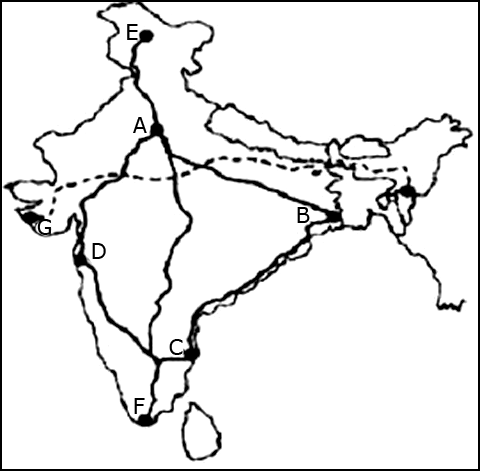
(8.1) Name the expressway national highway that will join stations E and F .
(8.2) Name the cities related to E and F stations . Marks:2View AnswerAnswer:
(8.1) North-South corridor.
(8.2) E is Srinagar and F is Kanyakumari. -
Q2
Name the Chola temple in Thanjavur. What is the most striking feature of this temple? Marks:2View AnswerAnswer:
The name of the Chola temple is the Rajarajeshwara Temple . The striking feature of this temple is that the top of the Shikhara weighs 90 tonnes. It was lifted to the top at a time when there was no crane facility as we have in our modern period. -
Q3
Mention any two main characteristics of Mughal paintings of Akbar and Jahangir’s time . Marks:2View AnswerAnswer:
(i) During the rule of Akbar, paintings were organised in an imperial establishment called karkhanas in which a large number of painters from different backgrounds gathered and painted pictures. Most of the paintings were on themes such as Indian scenes and landscapes. European paintings were also introduced. (ii) During the reign of Jahangir, a special progress was made in portrait painting and painting of animals. -
Q4
Define economic and non-economic activities and give one example of each. Marks:2View AnswerAnswer:
Those activities that give an income are called economic activities. For example, people working in farms. Those activities that do not produce any income are called non-economic activities. For example, people doing social work. -
Q5
How does rapid growth of population create unemployment? Give any two points. Marks:2View AnswerAnswer:
Whenever the growth of population is more as compared to resources, then it creates unemployment. (i) Rapid growth of population creates burden on the land which results in increase in agricultural holdings and landless labours. (ii) Increase in population increases the burden on economic infrastructure such as transport, communication, power etc. which reduces the production and leads to unemployment. -
Q6
Explain the term ‘poverty’. Marks:2View AnswerAnswer:
Poverty is the state of being extremely poor without food and other basic elements such as clothing and housing. Intake of insufficient food by a man can also be defined as poverty. Since poverty can be defined relatively from different perspectives and dimensions, lack of any basic need can be defined as poverty. -
Q7
Explain briefly the two approaches by which the number of the poor in the country is estimated. Marks:2View AnswerAnswer:
Income method – In this approach, all those families whose total income in a month is less than the poverty line as fixed by the government are considered to be below poverty line families. E xpenditure Method- The total minimum food requirement is measured in calories and this calorie amount is then converted into money value. A minimum amount of clothes and other requirements are also added with money value of food requirement. The total amount is considered to be a poverty line.All those families which spend less than poverty line amount is considered to be below poverty line. -
Q8
What does ‘health’ mean? Explain briefly. Marks:2View AnswerAnswer:
Out of syllabus -
Q9
What is meant by the two types of natural resources? Give one example of each.1+1=2 Marks:2View AnswerAnswer:
The two types of natural resources are:
1. Biotic Resources: Flora and Funa.
2. Abiotic Resources: Land. -
Q10
What are protected forests? What is the percentage of the total forest cover under this category ? 1+1=2 Marks:2View AnswerAnswer: